
By Thornical Press –
November 2, 2025
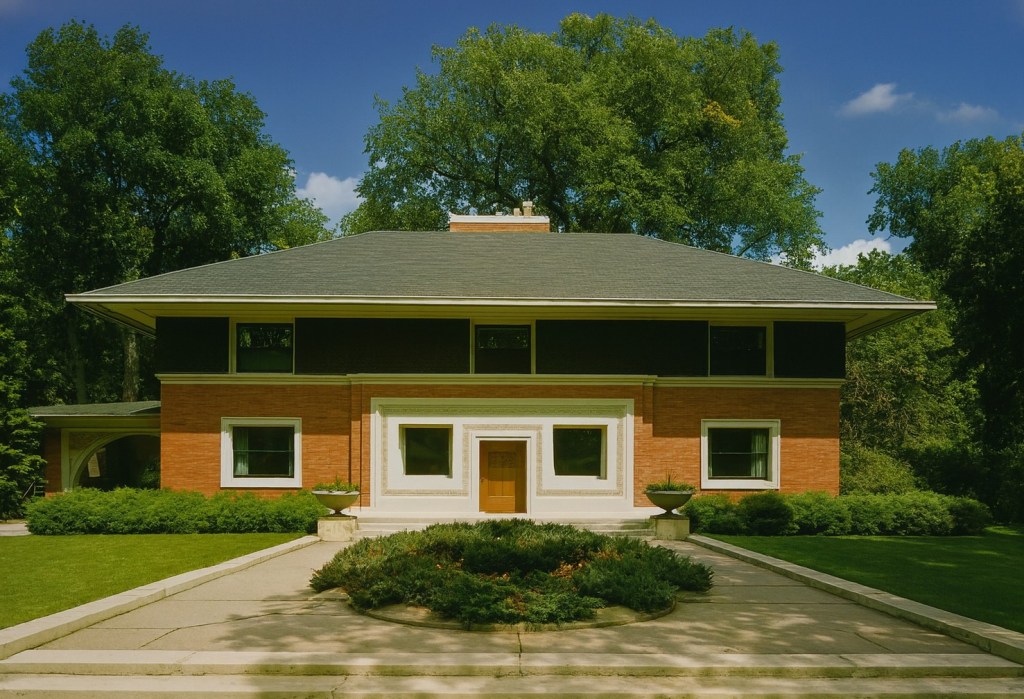
The Winslow House in River Forest, Illinois stands as Frank Lloyd Wright’s first major independent commission and a decisive moment in the emergence of the Prairie School. Built in 1893–94 for William H. Winslow, a manufacturer of decorative ironwork and a well-connected figure in Chicago’s design circles, the house announced Wright’s break with Victorian eclecticism and his early exploration of horizontality, integrated ornament, and a new domestic order that privileged interior life over external display. Wright later described the project as an origin point for the prairie house; its disciplined massing, dominant hearth, and clear tripartite elevation foreshadowed themes he would refine throughout his career.
At street level the Winslow House reads with a formal clarity uncommon in the proliferating Queen Anne and neo-Tudor houses of its day. Wright organized the facade into a solid stone base, a broad middle volume faced in long Roman brick, and a decorative terra-cotta frieze that creates a ribbon-like crown. This three-part composition yields a low, grounded silhouette that resists the vertical exuberance of the Victorian idiom and instead emphasizes a horizontal continuity that visually hugs the Midwestern landscape. The careful proportioning of mass and void gives the house both monumentality and domestic intimacy: large planes of brick are punctuated by bands of windows and ornament so that the whole reads as a cohesive, crafted object rather than a collage of applied styles.
Inside, Wright arranged the plan around a central fireplace that confronts the entry, establishing the hearth as the organizing nucleus of family life. Primary living spaces occupy the principal floor while private chambers are set above, an ordering that signals Wright’s interest in functional clarity and social hierarchy without resorting to ostentation. Circulation is designed to draw occupants inward, through layered thresholds and carefully placed windows that control views to the exterior and modulate light. This choreography of space, proportion, and light marked a clear departure from the compartmentalized Victorian house and pointed toward the spatial openness and flow that would characterize Wright’s mature work.
The color strategy of the Winslow House is subdued and deeply rooted in material truth. Wright favored warm, earthy tones that anchor the building to its context and emphasize material honesty rather than decorative paint. The most visually arresting surface is the long Roman brick that wraps the main volumes in a golden ochre. This brick, with its elongated proportions and fine mortar joints, reads almost sunlit against the darker stone base and the reddish-brown terra-cotta frieze. The subtle interplay of these hues—golden brick, gray-brown stone, and warm terra cotta—creates a calm chromatic harmony that underscores the house’s horizontality and domestic warmth rather than theatricality.
Interior colors follow the same restraint: natural wood finishes, muted plaster tones, and the soft, variegated light filtered through leaded-glass windows. The leaded panes do more than ornament; they fragment strong daylight into a honeyed glow that enriches textures and softens surfaces. Wright’s palette privileges the intrinsic beauty of materials—brick, stone, wood, glass—allowing texture and tone to compose a gentle, tactile interior atmosphere rather than relying on painted surfaces or heavy patterning. The result is an environment that feels both dignified and intimately scaled.
Material choices in the Winslow House are both pragmatic and expressive, reflecting Wright’s early but firm convictions about craft and honesty. The stone base, sometimes called a water table, physically anchors the house and addresses the practical needs of a damp Midwestern climate. Above it, the Roman brick is laid in extended horizontal runs to emphasize lateral continuity and to create the planar expanses that became a Prairie hallmark. The earth-toned brick produces a warm, tactile field that reads differently over the course of a day and invites close inspection of its joints and coursing.
Terra-cotta ornament provides a lyrical counterpoint to the masonry. Wright adopted Sullivanesque vegetal and geometric motifs in a frieze that enlivens the roofline without dissolving the building’s planar clarity. These decorative bands are never gratuitous; they function as measured punctuation, tying the house to the emergent modern American vocabulary of ornament as integrated element rather than applied afterthought. Ironwork, likely resonant with Winslow’s own craft background, appears in gates and details, reinforcing the collaboration between client skill and architectural intent.
Fenestration in the Winslow House plays a critical role in mediating interior experience. Tall, narrow sash windows—sometimes referred to as guillotine windows—are grouped and proportioned to control sightlines and daylight. Leaded glass within these windows fragments and diffuses incoming light, creating interior gradations that highlight wood grain and plaster texture. Wright’s careful placement of windows balances privacy and openness, animating interiors while shielding them from intrusive street views.
Craftsmanship in the Winslow House is evident in jointing, masonry pattern, metalwork, and glass; Wright deliberately emphasized fine workmanship over ornate surface treatment. Materials are celebrated in their natural states, and ornament is integrated at scales that respect both human touch and the building’s overall composition. This approach—honesty of material, measured ornament, and meticulous craft—helped crystallize the Prairie language and influenced generations of architects who sought to reconcile decoration with structural and programmatic clarity.
Over the past century the Winslow House has required ongoing stewardship to preserve its material integrity. Masonry, terra cotta, and leaded glazing each present conservation challenges, and preservation work has focused on retaining Wright’s intended warmth and tactility while repairing weathering and structural stresses. The house’s continued presence on preservation registers attests to its importance as a touchstone in American architectural history and as an early, eloquent statement of Wright’s developing ideals.
The Winslow House remains a compact manifesto rendered in brick, stone, and terra cotta: a composition in warm tones and honest materials that supports spatial invention and a new domestic ideal. Its color and materiality are inseparable from its ideas about proportion, craftsmanship, and the scale of human life, making the house essential for understanding how Frank Lloyd Wright fused material truth with architectural imagination to create something distinctly modern yet intimately humane.

 Thornical Press