
By Thornical Press –
November 16, 2025
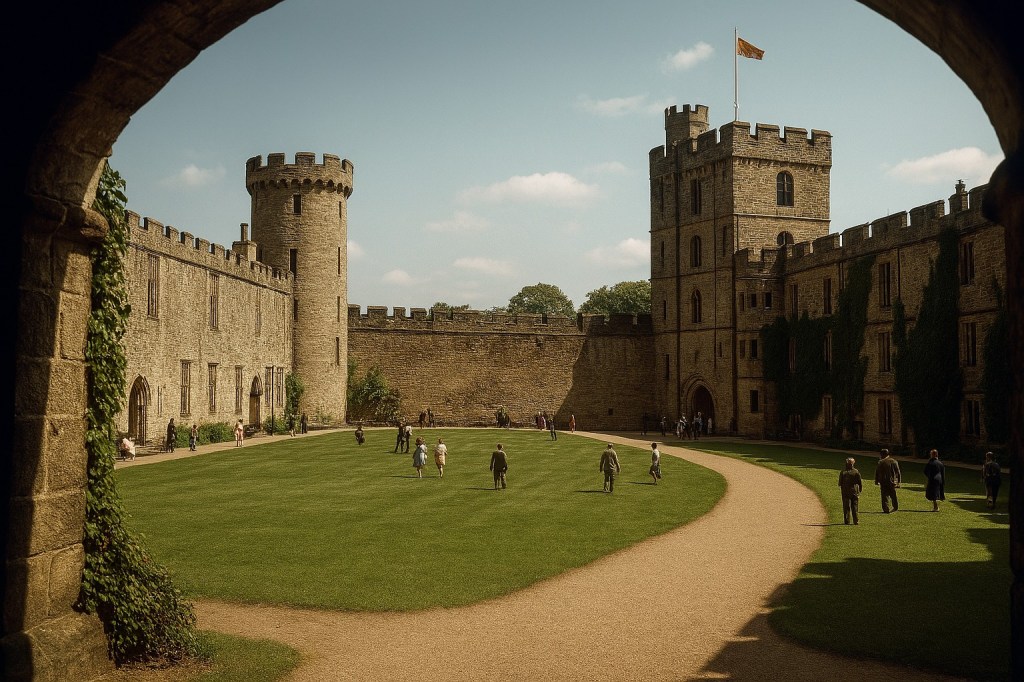
The bailey is the beating heart of an English castle, an open courtyard whose ordinary appearance masks a complex choreography of daily life, military logic, and symbolic power. Early chroniclers and modern historians use the terms ward and bailey almost interchangeably to describe these leveled enclosures, usually ringed by curtain walls and sometimes subdivided into inner, middle and outer compartments depending on size and purpose. In the motte-and-bailey castles of the Norman Conquest the bailey provided the practical, inhabitable space that the motte’s keep could not: a place for stables, workshops, kitchens and makeshift barracks, all held within a defensible perimeter. That juxtaposition — a high, compact stronghold above and an expansive, mutable yard below — shaped how castles functioned as both forts and settlements.
Functionally the bailey was a hybrid: domestic precinct, logistical hub and first line of defence. Within its walls you find the day-to-day infrastructure a garrison and household required — provisioning stores, smithies, bakeries and latrines — arranged with a pragmatic eye to access and safety. The inner bailey typically housed the most important and prestigious structures, like the great hall and sometimes the keep itself, while outer baileys were more utilitarian: housing animals, craftspeople and supplies that could be sacrificed in an emergency without imperilling the core stronghold. This layered arrangement let castle designers balance comfort and status with military redundancy: if attackers breached the outer bailey they still faced further obstacles before reaching the inner ward where governance and command were concentrated.
The defensive logic of multiple baileys becomes visible in castles that evolved beyond simple mottes into concentric and spur designs. A series of nested or sequential baileys turned the fortress into a staged obstacle course for an attacker, with each ward acting as a secure fallback and a controlled space for counterattacks. In some continental examples the narrow inter-wall spaces were intentionally engineered as killing grounds — confined zones where defenders could concentrate fire — and the same principle informed English developments when resources and topography allowed. But baileys were never purely military machines: their contours and compoundness also reflected topography and ritual. The placement of a chapel or the orientation of a hall within a bailey spoke to status and governance nearly as loudly as battlements did to military resolve.
Beyond immediate warfare, the bailey ran the economy and the social theater of a castle. Markets, musters and public punishments could be staged in the yard; craftsmen worked where the smoke and clatter did not spoil the lord’s halls; soldiers drilled and animals were kept. As administrative centers expanded under royal authority, larger castles turned baileys into multifunctional precincts where legal, fiscal and social orders overlapped. The bailey thus meditated between the private power of the lord and the public needs of the community that sustained the fortress. Its walls enclosed not just people and property, but a miniature civic ecology — the networks of labour, supply and obligation that made military authority sustainable.
Architecturally, the evolution of baileys traces a movement from timber palisades to stone curtain walls and more sophisticated gatehouses. The earlier, often irregular enclosures followed the lay of the land; later, as stonework and siege craft both advanced, planarity and concentric regularity became prized for their defensive coherence. Where space permitted, castles acquired a distinct inner sanctum around the keep and a series of outer enclosures that might hold rings of terraces, gardens, or utilitarian annexes. Yet even in late medieval castles the character of a bailey could be conservative: outer wards remained places of necessary mess and industry, while inner wards maintained ceremonial functions, ceremonial access and the projection of lordly order.
Understanding the bailey is essential to understanding castles as lived places rather than as sterile monuments of war. These yards were the liminal zone where the strategies of defense met the contingencies of daily life, where the theatre of power was rehearsed in processions, legal enactments and the daily rhythms of food, work and guard duty. To walk through a well-preserved bailey is to step into that blended logic — to see where a flagstone may stand for jurisdiction as much as for flooring, where a tack room says as much about supply chains as it does about horsemanship, and where the spatial choreography still whispers how medieval rulers kept people, provisions and potential violence in uneasy but managed proximity. The bailey, then, is not a mere empty space: it is the castle’s operational brain, simultaneously practical, performative and perilously exposed.

 Thornical Press