
By Thornical Press –
December 3, 2025
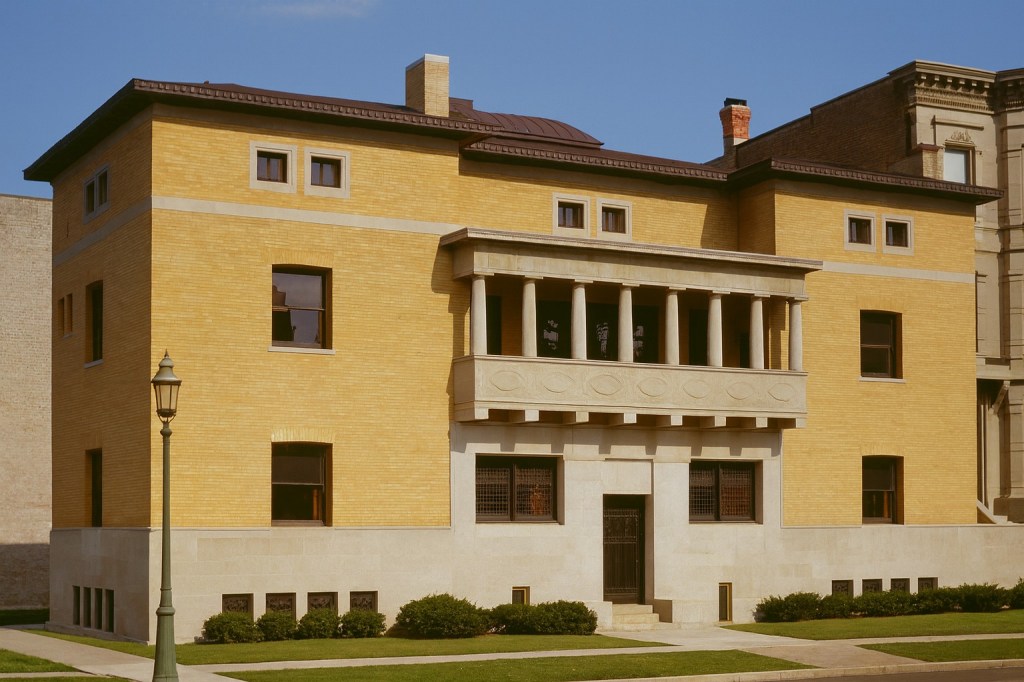
The Charnley House was commissioned by lumberman James Charnley and completed in 1892 by the office of Adler & Sullivan, with the young Frank Lloyd Wright playing a significant role in the design; it stands on a narrow Gold Coast lot and is recognized today as both a Chicago landmark and a National Historic Landmark. Its compact three‑story massing and restrained façade marked a deliberate move away from the exuberant Victorian vocabulary then common in the city, favoring planar surfaces, geometric order, and a material honesty that would influence generations of architects.
At the heart of the house’s presence is its load‑bearing masonry. A substantial limestone base anchors the façade, forming a low garden wall that gives the narrow townhouse a grounded, monumental quality. Above this base the main volumes are clad in tan Roman brick, laid to emphasize horizontal continuity and to create a warm, planar field against which stone frames and wooden projections read clearly. The east party wall, built in Chicago common brick, is largely windowless—a pragmatic response to lot constraints and fire‑separation practices—so that the public face of the house could remain composed and sculptural. These choices reflect a construction logic in which stone conveys permanence, brick defines plane, and masonry carries the structural load, allowing ornament to be used sparingly and with intent.
Where many contemporaneous houses spread ornament across every surface, the Charnley House concentrates its tactile detail. A recessed central bay contains a projecting wooden loggia and an inset balcony whose carved and fret‑sawn wooden panels provide the building’s most intimate textures. The use of painted pine friezes and multi‑layered fretwork demonstrates a careful balancing act: wood supplies human scale and delicate patterning without undermining the overall geometric restraint. Recent photographic and material studies have underscored Sullivan and Wright’s experimental use of wood as a medium for abstract ornament, revealing how carved and layered timber elements were employed to bridge organic motifs and geometric discipline in the late 19th century.
The house’s exterior has not remained untouched by time; a 20th‑century addition disrupted the original symmetry until a major restoration in the 1980s returned the façade to its 1891 configuration and removed later accretions. That restoration prioritized material authenticity—repairing limestone, repointing Roman brick, and conserving surviving woodwork—so the building today reads as an early manifesto of material honesty and careful construction technique. The Charnley House’s enduring lesson is architectural restraint: by limiting its palette to limestone for grounding, Roman brick for planar warmth, and carved wood for focused ornament, and by letting masonry carry the structural burden, the house achieves a modern clarity that still feels radical more than a century later.


 Thornical Press