
By Thornical Press –
December 15, 2025
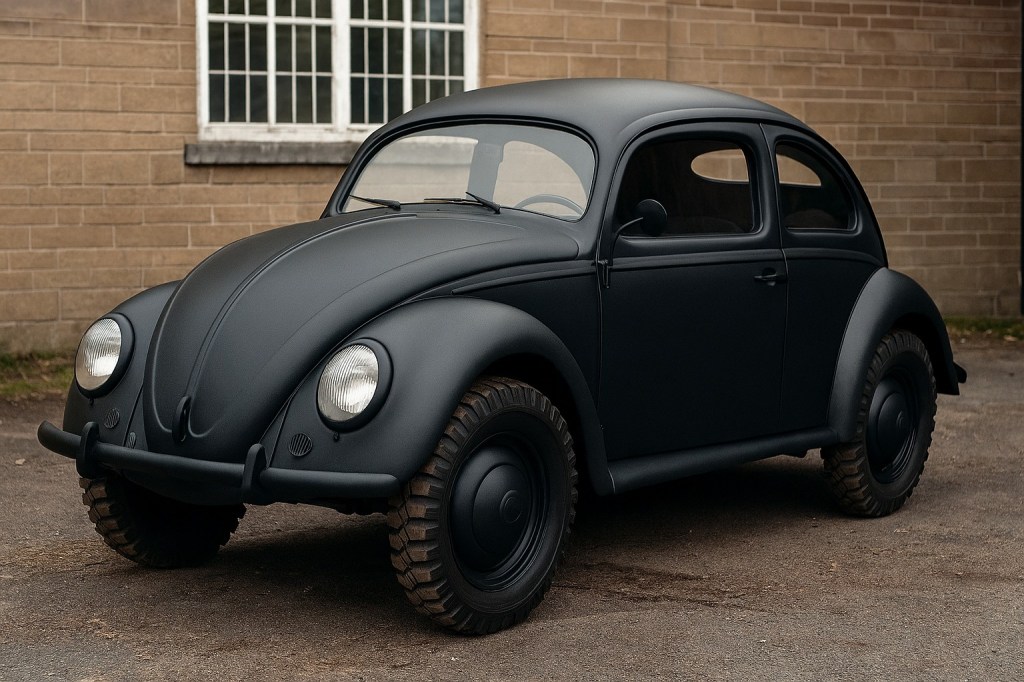
The Volkswagen Type 82E was a wartime adaptation of the civilian Volkswagen Beetle (KdF‑Wagen) developed to meet specific military needs during World War II. Unlike the more widely known Kübelwagen Type 82 — a purpose‑built light utility vehicle derived from Beetle components — the Type 82E retained much of the Beetle’s closed‑body form while incorporating military fittings and ruggedized components for service with German armed and government units. The Type 82E occupies a distinct place in wartime Volkswagen history: it represents the direct militarization of the Beetle platform rather than the open‑topped, cross‑country Kübelwagen derivative.
The design philosophy behind the Type 82E was pragmatic: adapt an existing, mass‑producible civilian car for military use with minimal reengineering. The vehicle used the Beetle’s backbone layout and rear‑mounted, air‑cooled flat‑four engine, which offered simplicity, low maintenance, and resilience in harsh environments because it eliminated vulnerable liquid‑cooling systems. The closed body of the Type 82E made it more familiar in silhouette to civilian Beetles, but military versions were fitted with blackout lighting, reinforced mounting points for equipment, and simplified interior fittings to ease field maintenance and reduce production complexity.
Structurally, the Type 82E shared the Beetle’s torsion bar suspension and independent wheel movement, giving it a comfortable ride on roads and reasonable articulation off‑road for a two‑wheel‑drive vehicle. The emphasis was on economy of production and logistical compatibility: common parts, shared assembly processes, and interchangeability with civilian spares reduced the strain on wartime supply chains and allowed workshops to keep vehicles operational with basic tools and limited inventories.
At the heart of the Type 82E was the familiar air‑cooled boxer engine. This engine type was chosen for its robustness and low service requirements; it tolerated extremes of temperature and did not rely on radiators or coolant that could be punctured in combat. The rear‑engine layout improved traction for the driven wheels under load and simplified drivetrain packaging. The gearbox was a simple four‑speed manual, and many military Beetle variants received reinforced clutch and transmission components to cope with heavier use and rougher terrain than civilian examples typically encountered.
Because the Type 82E was not a four‑wheel‑drive vehicle, its off‑road capability was inherently limited compared with specialized military 4x4s. Designers compensated where possible with gearing choices that favored low‑speed torque and with suspension tuning that allowed the car to traverse rutted tracks and firm off‑pavement surfaces more effectively than an unmodified civilian car. The result was a vehicle that performed well as a personnel carrier and liaison car on roads and light tracks, but which was not intended to replace purpose‑built cross‑country vehicles in the most demanding terrain.
It is important to distinguish the Type 82E from the Kübelwagen Type 82. The Kübelwagen was an open‑topped, purpose‑designed military utility vehicle optimized for cross‑country mobility, featuring portal gear reduction and other off‑road‑oriented features. By contrast, the Type 82E was essentially a militarized Beetle: closed bodywork, Beetle‑style ergonomics, and fewer specialized off‑road adaptations. The Type 82E’s role was therefore different — it served as a staff car, personnel transport, and general utility vehicle where the Kübelwagen’s open design and superior cross‑country performance were not required.
Military Beetle variants like the Type 82E entered production during the early 1940s as Volkswagen’s factory shifted from civilian KdF production to war work. The Type 82E was produced in limited numbers compared with the Kübelwagen family, and it was primarily allocated to personnel transport, administrative duties, and government use rather than front‑line reconnaissance or supply tasks that demanded higher off‑road capability. Surviving records and restoration projects show that many Type 82E examples were adapted in the field, with units adding radio mounts, map cases, and other mission‑specific fittings as required.
Because the Type 82E shared many components with civilian Beetles, captured or abandoned vehicles were often pressed into service by occupying forces or local authorities after the war. Restoration specialists today note that original wartime parts for the Type 82E can be scarce, and careful reproduction work is frequently necessary to return surviving examples to authentic condition.
The Type 82E’s strengths flowed from its simplicity, parts commonality, and ease of maintenance. Field mechanics familiar with the Beetle could service the Type 82E with basic tools, and the air‑cooled engine reduced the number of failure modes associated with liquid cooling. Its closed body offered better protection from the elements for occupants and equipment than open‑topped utility vehicles, making it suitable for staff officers, signals personnel, and administrative transport.
Limitations were equally clear: without four‑wheel drive or portal axles, the Type 82E could be outperformed by dedicated military 4x4s in deep mud, snow, or sand. Its payload and towing capacity were modest, and its narrow track and light weight could be a disadvantage in extremely soft ground where flotation and traction were critical. Commanders therefore used the Type 82E where its advantages — economy, availability, and road performance — matched mission requirements, while relying on Kübelwagens, Schwimmwagens, and Allied jeeps for the most demanding cross‑country tasks.
After the war, many Type 82E vehicles were left behind, repurposed, or scrapped. A number survived and have since been restored by museums and private collectors; restoration accounts document both the vehicle’s historical role and the technical challenges of preserving a militarized Beetle variant. The Type 82E’s legacy is twofold: it illustrates how a mass‑market civilian design can be adapted for military use with minimal changes, and it highlights the tradeoffs between specialization and standardization that wartime production forces upon manufacturers and armed forces alike.
Today the Type 82E is a niche but important subject for historians and enthusiasts interested in Volkswagen’s wartime output and in the broader story of how industrial platforms were repurposed for conflict. Surviving examples and museum exhibits help clarify the distinctions between the Type 82E and the Kübelwagen family, ensuring that the Type 82E’s specific role as a military Beetle is not conflated with the open‑topped cross‑country Kübelwagen that is often more widely recognized.
 Thornical Press