By Thornical Press –
January 7, 2026
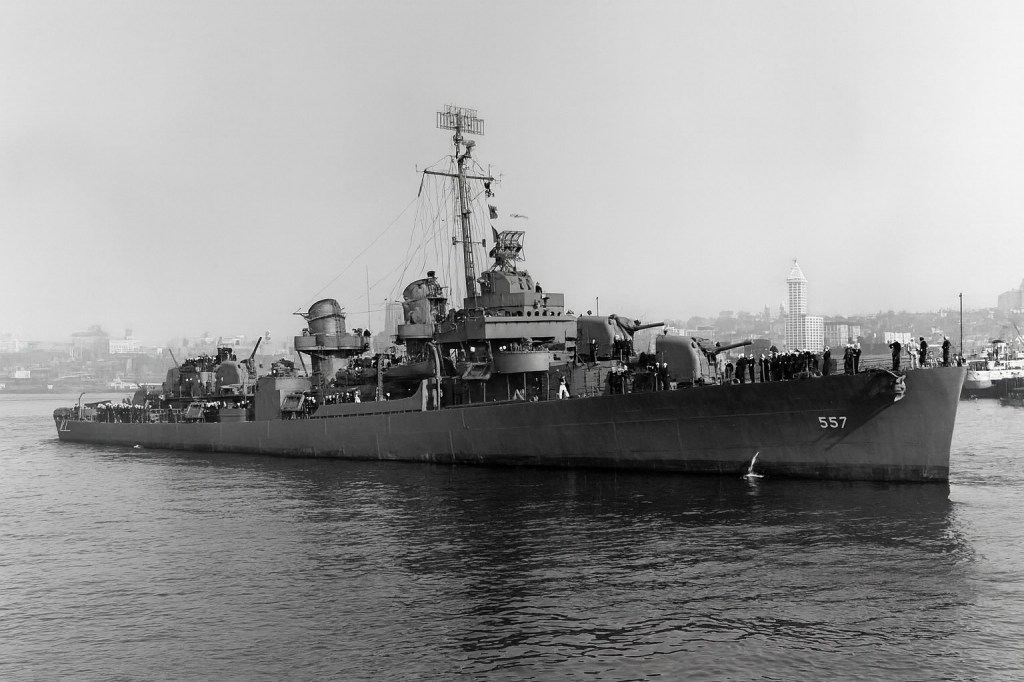
The USS Johnston (DD‑557) entered the world quietly on 25 March 1943, sliding down the ways at the Seattle‑Tacoma Shipbuilding Corporation. She was one of 175 Fletcher‑class destroyers built during the war, but from the moment she touched the water, she carried the promise of something more. Sleek, fast, and heavily armed for her size, she embodied the U.S. Navy’s evolving doctrine of aggressive, flexible surface warfare. When she was commissioned on 27 October 1943 under Lieutenant Commander Ernest E. Evans, that promise became a mission. Evans, a man of fierce conviction and unshakable resolve, told his crew during the ceremony that theirs would be a fighting ship, and that he intended to go in harm’s way. Anyone unwilling to follow him, he said, should step off immediately. No one did.
The Johnston displaced just over 2,100 tons and stretched 376 feet from bow to stern. She carried five 5‑inch guns, ten torpedo tubes, depth charges, and an array of anti‑aircraft weapons. Her engines could push her to 38 knots, making her one of the fastest and most maneuverable ships in the Pacific. She was built to escort carriers, screen larger ships, hunt submarines, and deliver precise naval gunfire in support of amphibious landings. In short, she was built for the kind of war the United States was fighting across the Central Pacific.
After shake-down training along the West Coast, the Johnston joined the Pacific Fleet, where she quickly proved her worth. Her early assignments included escort duty and anti‑submarine patrols, missions that demanded constant vigilance and tight coordination. These operations hardened the crew, sharpened their reflexes, and forged the discipline that would define the ship’s later actions. Though the Johnston would ultimately become famous for her final stand at the Battle off Samar, her first major combat operations came months earlier, during the Gilbert and Marshall Islands campaign. It was there, in the crucible of amphibious warfare, that the ship and her crew first demonstrated the aggressive spirit Evans had instilled in them.
By late 1943, the United States had seized the strategic initiative in the Pacific. The island‑hopping strategy—capturing key atolls while bypassing others—required overwhelming naval power to soften Japanese defenses before troops went ashore. The Gilbert Islands, followed by the Marshall Islands, were the first major steppingstones on the long road toward the Marianas, the Philippines, and ultimately Japan itself. These operations demanded destroyers capable of delivering accurate, sustained fire close to shore. The Johnston, barely three months old, was thrust into this demanding role.
Her first major test came at Kwajalein Atoll in the Marshall Islands. On 1 February 1944, the Johnston joined the naval bombardment that preceded the U.S. Marine and Army landings. Kwajalein was heavily fortified, with Japanese defenders entrenched in bunkers, pillboxes, and interlocking fields of fire. The Johnston’s mission was to break these defenses before the landing craft approached the beaches. Her gunners, many of whom were seeing combat for the first time, performed with remarkable precision. The ship maneuvered close to shore, firing on pillboxes, trenches, and fortified positions that larger ships could not safely target. Her bombardment helped neutralize key strongpoints, reducing casualties among the assault troops and contributing directly to the rapid capture of the atoll.
The success at Kwajalein was followed quickly by the assault on Eniwetok Atoll, another critical objective in the Marshalls. From 17 to 22 February 1944, the Johnston provided five days of continuous naval gunfire support. The fighting at Eniwetok was intense, with Japanese defenders dug in across multiple islands. The Johnston’s guns were in near‑constant use, targeting blockhouses, dugouts, and defensive positions that threatened the landing forces. Her fire was credited with destroying several fortifications and suppressing enemy positions that could have inflicted heavy casualties on the assault troops. The ship’s ability to maintain accuracy over extended periods demonstrated the crew’s growing professionalism and endurance.
After the Marshalls, the Johnston briefly shifted to other duties, including a bombardment of Kapinga‑marangi Atoll in the Caroline Islands on 28 March 1944. There, she destroyed an observation tower, blockhouses, and additional beach defenses. She then moved to Bougainville in the Solomons, conducting anti‑submarine patrols and sinking the Japanese submarine I‑176 on 15 May 1944. These operations, though outside the Marshalls campaign, further sharpened the crew’s combat readiness and reinforced the ship’s reputation as a reliable, aggressive combatant.
The Johnston’s contributions to the Gilbert and Marshall Islands campaign were significant for several reasons. First, her precision fire support played a crucial role in neutralizing Japanese defenses before amphibious landings. Destroyers were essential for close‑in bombardment, and the Johnston excelled in this demanding role. Second, the ship demonstrated the operational tempo required in the Pacific, moving rapidly from one operation to the next without sacrificing effectiveness. Third, the campaign forged the crew into a cohesive, battle‑tested unit. Their experience under fire, their trust in one another, and their confidence in Evans’s leadership would prove vital later in the war. Finally, the Johnston’s performance illustrated the evolving nature of amphibious warfare. Naval gunfire support had become a science, requiring coordination between ships, aircraft, and ground forces. The Johnston adapted quickly to this environment, proving that a well‑led destroyer could deliver decisive effects on the battlefield.
These early operations also revealed the character of the ship and her captain. Evans’s philosophy of aggressive action shaped every engagement. He demanded readiness, precision, and courage, and his crew delivered. The Johnston’s actions in the Marshalls were not merely tactical successes; they were expressions of a fighting spirit that would later astonish even the most seasoned naval officers. The crew learned to fight together, to trust their captain, and to push their ship to its limits. By the time the Johnston joined the escort carrier group known as “Taffy 3” in October 1944, she was no longer a new destroyer. She was a hardened combat vessel with a crew that had survived bombardments, patrols, and submarine hunts. This experience would shape their response when confronted by the overwhelming Japanese Center Force at the Battle off Samar.
The Johnston’s role in the Gilbert and Marshall Islands campaign is sometimes overshadowed by her dramatic final battle, yet it was during these early operations that the ship and her crew forged their identity. Under Evans’s leadership, the Johnston became a fighting ship in every sense—aggressive, resilient, and unflinchingly committed to the mission. Her accurate gunfire at Kwajalein, her relentless bombardment at Eniwetok, and her rapid adaptation to the demands of amphibious warfare all contributed to the success of the U.S. advance across the Central Pacific. These achievements deserve recognition not only as military accomplishments, but as chapters in the story of a ship whose courage would later inspire generations.In the end, the Johnston met her fate with the same ferocity that had defined her service from the moment she was commissioned. On 25 October 1944, during the Battle off Samar, she charged headlong into a vastly superior Japanese force to shield the escort carriers of Taffy 3. Outgunned and taking heavy damage, she continued to fire until her guns fell silent, buying precious time for the carriers to escape. Riddled with shellfire and listing badly, the Johnston finally slipped beneath the waves, her colors still flying. Many of her crew were lost, including Commander Evans, who was last seen helping wounded sailors into the water. The ship’s sacrifice became one of the most celebrated acts of courage in U.S. naval history, a testament to a crew that fought far beyond the limits of steel and machinery. Her wreck would not be found until 2019 and confirmed in 2021, resting more than 20,000 feet below the surface, but her story endures as a symbol of duty, resolve, and the extraordinary bravery of ordinary men.
Feature Image: The U.S. Navy destroyer USS Johnston (DD-557), 10/27/1943 – US Navy.

 Thornical Press