
By Thornical Press
February 11, 2026
In the frosty air of 1923 Providence, Rhode Island, two brothers named Henry and Hillel Hassenfeld sat amidst piles of textile remnants, fueled by the kind of immigrant grit that defined the American Century. They had fled Poland seeking a new life, and their initial venture was as humble as it gets: selling fabric remnants to make liners for pencil boxes. It was a business of scraps and leftovers, a far cry from the multi-billion-dollar entertainment juggernaut that would one day dominate global toy shelves. This was the birth of Hassenfeld Brothers, a name eventually clipped into the punchy, iconic Hasbro. The transformation from a textile firm to a toy empire was not a singular stroke of genius but a decades-long evolution driven by an uncanny ability to read the zeitgeist and a willingness to gamble on the whims of children. By the 1930s, the brothers realized that the boxes they were lining were often more interesting to children than the pencils inside. They began manufacturing the boxes themselves, then added school supplies like clay and paint sets. It was a logical pivot; if they were already providing the tools for creativity, why not provide the creative outlet itself?
The company’s first true “hit” didn’t arrive until 1952, and it came from the most unlikely of sources: a kitchen pantry. George Lerner, an inventor who had observed children playing with vegetables and sticks to create makeshift dolls, pitched the idea of plastic facial features that could be stuck into real potatoes. The Hassenfeld brothers saw what others had dismissed as nonsense. Mr. Potato Head became the first toy ever advertised on television, a revolutionary move that bypassed parents and spoke directly to the “pester power” of children sitting in front of flickering black-and-white screens. It was a watershed moment for the industry. Suddenly, toys weren’t just objects bought by adults; they were brands demanded by kids. This marketing savvy would become the company’s North Star. As the post-war Baby Boom filled suburban neighborhoods with millions of potential customers, Hasbro was positioned to grow alongside them. The 1960s brought the next seismic shift in the company’s identity. Until then, “dolls” were strictly for girls, and no self-respecting boy in the Kennedy era would be caught dead with one. Hasbro’s designers, however, looked at the popularity of Barbie and wondered if they could replicate that success for boys.
The solution was a stroke of branding brilliance: G.I. Joe. By calling him an “Action Figure” instead of a doll, Hasbro created an entirely new category of play. Launched in 1964, the 12-inch soldier with “battle-scar” facial detail and poseable limbs became an instant sensation. G.I. Joe wasn’t just a toy; he was a reflection of Cold War masculinity and American pride. However, as the 1960s bled into the 1970s and the national mood soured on the Vietnam War, Hasbro faced its first major identity crisis. The “Man of Action” was suddenly out of step with a more cynical, anti-war public. Hasbro responded by pivoting G.I. Joe away from direct military combat and toward adventure and exploration—the “Adventure Team” years—equipping him with “Kung Fu Grip” and sending him to hunt “Atomic Man” rather than enemy soldiers. It was a lesson in corporate survival: adapt the brand to the culture, or perish.
The late 1970s and early 1980s were a period of massive consolidation and aggressive expansion. Stephen Hassenfeld, the grandson of Henry, took the helm and professionalized the family business, turning it into a lean, mean, toy-making machine. It was during this era that Hasbro mastered the art of the “media tie-in.” In 1982, they relaunched G.I. Joe as a smaller, 3.75-inch line, accompanied by a dedicated comic book series and a daily animated television show. This “synergy”—a buzzword that Hasbro practically invented—meant that children weren’t just buying a plastic figure; they were buying a story they had watched that morning. This formula reached its zenith in 1984 with the introduction of Transformers. Imported from Japan and rebranded with an epic backstory of warring alien robots, Transformers became a cultural phenomenon. The idea that a toy could be “more than meets the eye” captivated a generation of kids who spent their afternoons transforming jets into warriors.
As the 1980s closed, Hasbro began a shopping spree that would solidify its place as the king of the board game aisle. In 1984, they acquired Milton Bradley, bringing classics like Candy Land, Chutes and Ladders, and The Game of Life under their roof. In 1991, they made an even bigger splash by acquiring Tonka Corporation, which included Kenner Products and Parker Brothers. This meant Hasbro now owned Monopoly, the most famous board game in history, along with the rights to Star Wars toys—a license that would prove to be a golden goose for decades to come. By the mid-90s, Hasbro was no longer just a toy company; it was a portfolio manager of childhood nostalgia. They understood that a brand like Monopoly was evergreen, capable of being reimagined in thousands of different themes, from Star Wars to local cities.
The digital age, however, presented a new set of challenges. As children began gravitating toward video games and screens, the traditional plastic toy began to look like a relic of a bygone era. Hasbro’s response was to stop thinking of themselves as a manufacturer and start thinking of themselves as an “entertainment and play” company. This shift was led by Brian Goldner, who took over in the early 2000s. Goldner realized that Hasbro’s intellectual property—its “IP”—was its most valuable asset. If Marvel could turn comic books into a cinematic universe, why couldn’t Hasbro do the same with toys? This led to the massive Transformers film franchise, which, despite mixed critical reviews, raked in billions at the global box office and revitalized toy sales. It was a total reversal of the old model: instead of the toy inspiring a show to sell more toys, the movie became a global event that sustained the brand’s relevance across all platforms.
This strategy culminated in the 2019 acquisition of Entertainment One (eOne), a move that brought Peppa Pig and PJ Masks into the fold and gave Hasbro its own production studio. Hasbro was now a player in Hollywood, producing content for Netflix, Disney+, and movie theaters. They were no longer just competing with Mattel; they were competing with Disney and Warner Bros. Yet, even as they chased digital dreams and cinematic glory, the company remained tethered to its roots. The tabletop gaming division, led by Wizards of the Coast (acquired in 1999), became a surprise powerhouse. Dungeons & Dragons and Magic: The Gathering, once considered niche hobbies for “geeks,” exploded in popularity during the 2010s and 2020s, proving that in an increasingly digital world, people still craved the tactile, social experience of sitting around a table with friends.
The history of Hasbro is, in many ways, a history of the American family. It reflects our changing values—from the industriousness of the 1920s to the militarism of the 1960s, the consumerism of the 1980s, and the digital interconnectedness of today. The company has survived economic depressions, world wars, and the rise of the internet by being relentlessly adaptable. They have turned a potato into a celebrity, a soldier into an icon, and a game about real estate into a global rite of passage. Today, as Hasbro navigates a landscape defined by e-commerce, environmental concerns about plastic, and the ever-shortening attention spans of Gen Alpha, the spirit of the Hassenfeld brothers remains. It is the belief that play is a fundamental human need, and that a great story, whether told through a piece of plastic or a blockbuster film, will always find an audience. From the first scrap of fabric in a Rhode Island basement to a multi-national empire, Hasbro’s journey is a testament to the power of imagination—and the enduring business of being a kid at heart.
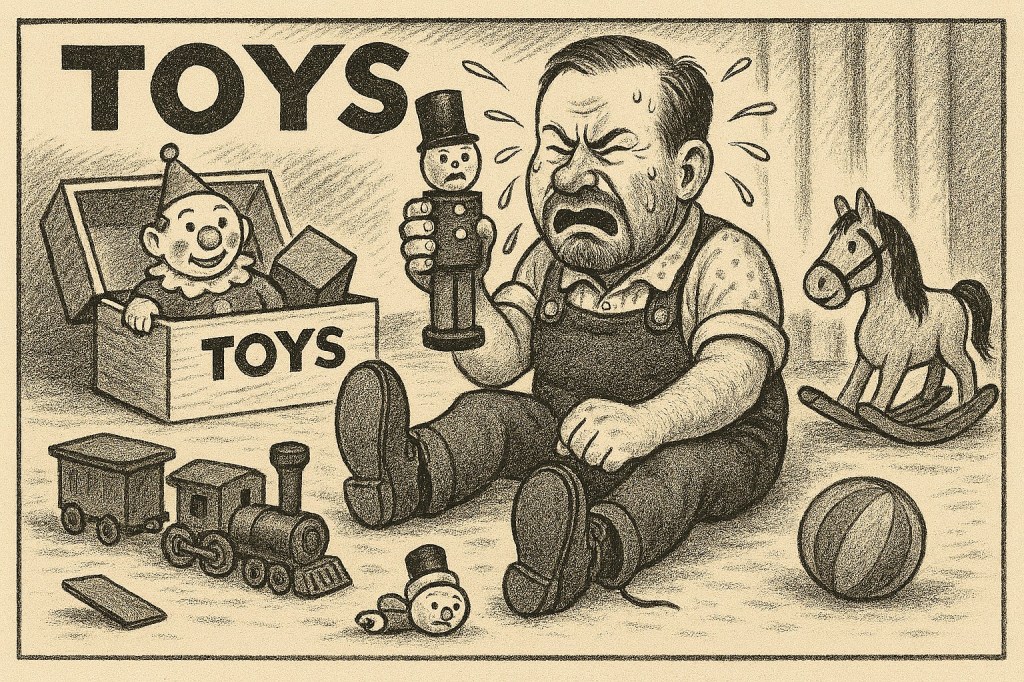
Feature image: Toys Make Me Mad – Thornical Press Artist

 Thornical Press