
By Thornical Press
March 26, 2026
A Gibbs surround carries a peculiar magnetism in architectural history, the kind that makes a doorway or window feel weightier, more ceremonial, and more self‑aware than the wall that contains it. Emerging from the work of the English Baroque architect Sir James Gibbs in the early eighteenth century, the surround became a signature device—part ornament, part structural illusion, part theatrical flourish. It is, at its core, a way of framing an opening so that it appears more substantial and more sculptural, using bold blocks, alternating projections, and emphatic moldings to create a sense of depth and gravitas. Yet the Gibbs surround is more than a decorative border. It is a study in how architecture can manipulate perception, elevate the ordinary, and communicate hierarchy through the simplest of elements: the threshold.
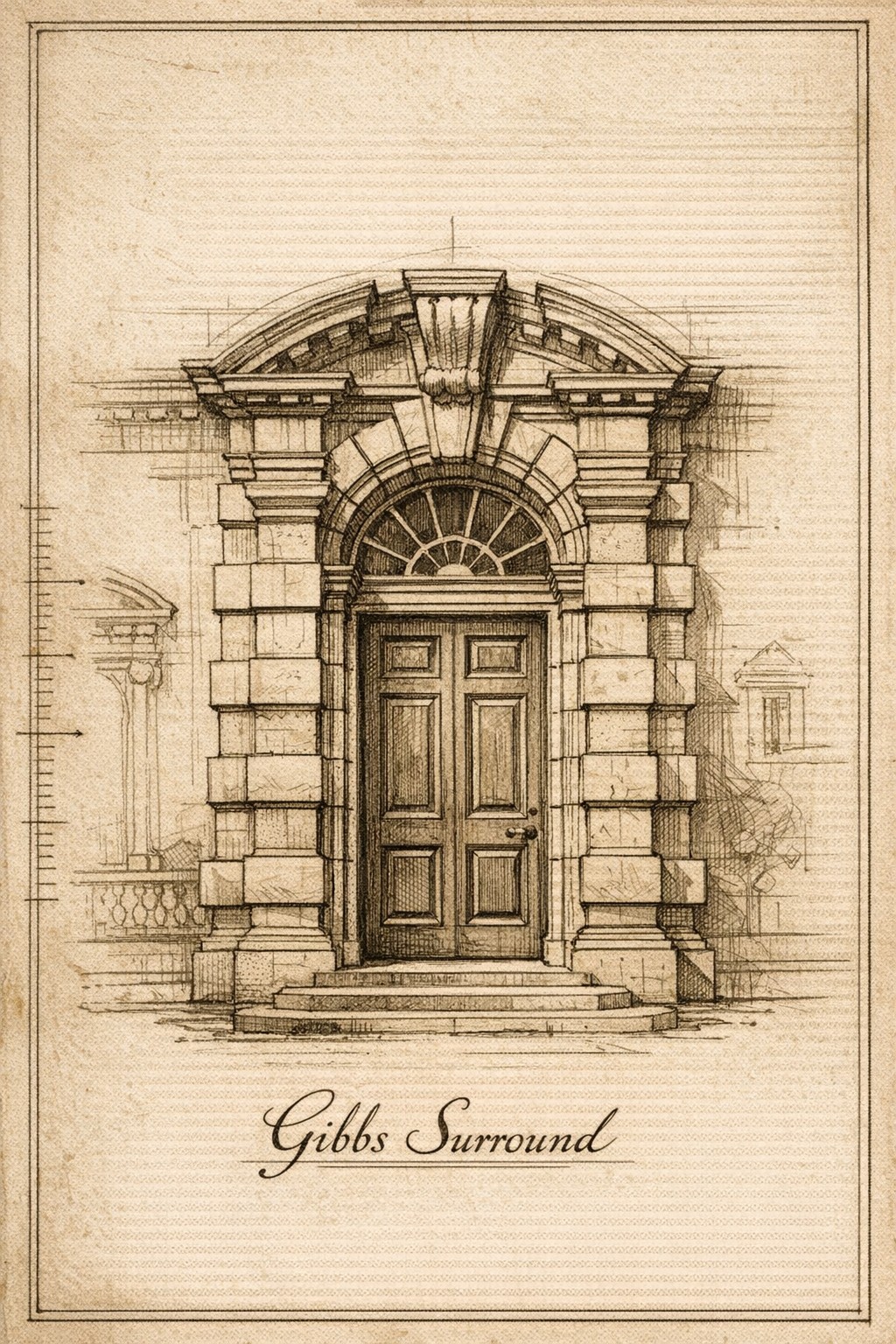
Gibbs developed his surround at a moment when English architecture was absorbing continental Baroque influences but still clinging to a restrained classicism. His solution was a hybrid—visually assertive but not overwrought, muscular but still rooted in classical proportion. The typical Gibbs surround features chunky blocks or “quoins” arranged around a door or window, often alternating between projecting and recessed stones to create a rhythmic, almost sculptural texture. A keystone, sometimes exaggerated in size, anchors the composition at the top, while the sides may flare outward or step in and out to heighten the sense of movement. The result is an opening that feels carved rather than merely cut, as if the building’s façade has been chiseled away to reveal something important within.
This sense of importance is not accidental. In the eighteenth century, the Gibbs surround became a shorthand for prestige. It appeared on churches, civic buildings, and grand houses, marking the main entrance as a place of ceremony. Even when used on windows, the surround signaled hierarchy: principal rooms received the most elaborate treatment, while secondary spaces were framed more modestly. The surround thus functioned as a visual language, communicating social order through stone. Gibbs himself employed the motif in some of his most notable works, including St. Martin‑in‑the‑Fields in London, where the bold surrounds punctuate the otherwise restrained façade, giving the church a sense of sculptural vitality.
As the motif spread, it evolved. Georgian builders adopted simplified versions, using brick instead of stone or flattening the projections to suit more modest budgets. In colonial America, the Gibbs surround became a favorite of ambitious builders eager to signal refinement. Wooden versions appeared on houses from New England to the Mid‑Atlantic, their carved blocks painted to mimic stone. Even in these humbler materials, the surround retained its expressive power. It made a house look more substantial, more urbane, more connected to the architectural fashions of London. The motif’s adaptability—stone or wood, grand or modest—helped it endure far beyond Gibbs’s lifetime.
The surround’s enduring appeal lies partly in its ability to manipulate light and shadow. The alternating blocks catch sunlight at different angles, creating a lively play of highlights and recesses. This chiaroscuro effect gives the façade a sense of depth, even when the wall itself is flat. In an era before electric lighting, such visual drama mattered. It made buildings feel animated, responsive to the changing daylight, and more engaging to the passerby. The surround also provided a tactile quality, inviting the eye—and sometimes the hand—to trace its contours. Architecture, after all, is not only seen but experienced physically, and the Gibbs surround heightens that experience at the very point where one crosses from outside to inside.
Modern architects have approached the Gibbs surround with a mix of admiration, reinterpretation, and occasional irony. In the twentieth century, as modernism rejected ornament, the surround fell out of favor, dismissed as a relic of a more decorative age. Yet even then, its influence lingered. Some architects abstracted its principles—emphasizing the threshold, deepening the reveal, or using bold geometric frames—without replicating its classical vocabulary. Postmodern designers, meanwhile, embraced the surround with gusto, sometimes exaggerating its proportions or rendering it in unexpected materials as a playful nod to architectural history. In contemporary practice, the Gibbs surround appears in both traditional and modern contexts, proving that its underlying idea—the dramatization of the opening—remains compelling.
What makes the Gibbs surround especially resonant today is its clarity of purpose. In an age when façades can be complex, digital, or visually diffuse, the surround offers a moment of focus. It tells you where to look, where to enter, where the building’s narrative begins. It frames the threshold as an event, not an afterthought. This is particularly relevant in public architecture, where wayfinding and symbolic clarity matter. A well‑designed surround can guide visitors intuitively, signaling welcome or ceremony without a single word.
There is also something deeply human about the Gibbs surround. It acknowledges that thresholds are psychologically charged spaces—points of transition, anticipation, and encounter. By giving the doorway a sculptural frame, the architect elevates that moment, making it feel intentional and even ritualistic. Whether one is entering a church, a courthouse, or a home, the surround heightens the experience, reminding us that architecture shapes not only our movement but our emotions.
In preservation circles, the Gibbs surround remains a beloved detail, often restored with great care because it carries so much of a building’s character. In new construction, it offers designers a way to connect with historical precedent while still exercising creativity. The surround can be rendered in steel, concrete, or composite materials; it can be minimalist or exuberant; it can be literal or abstract. What matters is the idea: the opening as a sculptural moment, a place where architecture pauses to acknowledge the significance of passage.
The Gibbs surround endures because it solves a timeless architectural challenge—how to make an opening feel meaningful. It does so with a combination of proportion, texture, and theatricality that transcends style. Whether on a Baroque church or a contemporary civic building, the surround reminds us that architecture is not merely about enclosing space but about shaping experience. And in a world where so much design strives for novelty, the Gibbs surround offers a lesson in the power of a well‑framed threshold.


 Thornical Press