
By Thornical Press
April 26, 2026
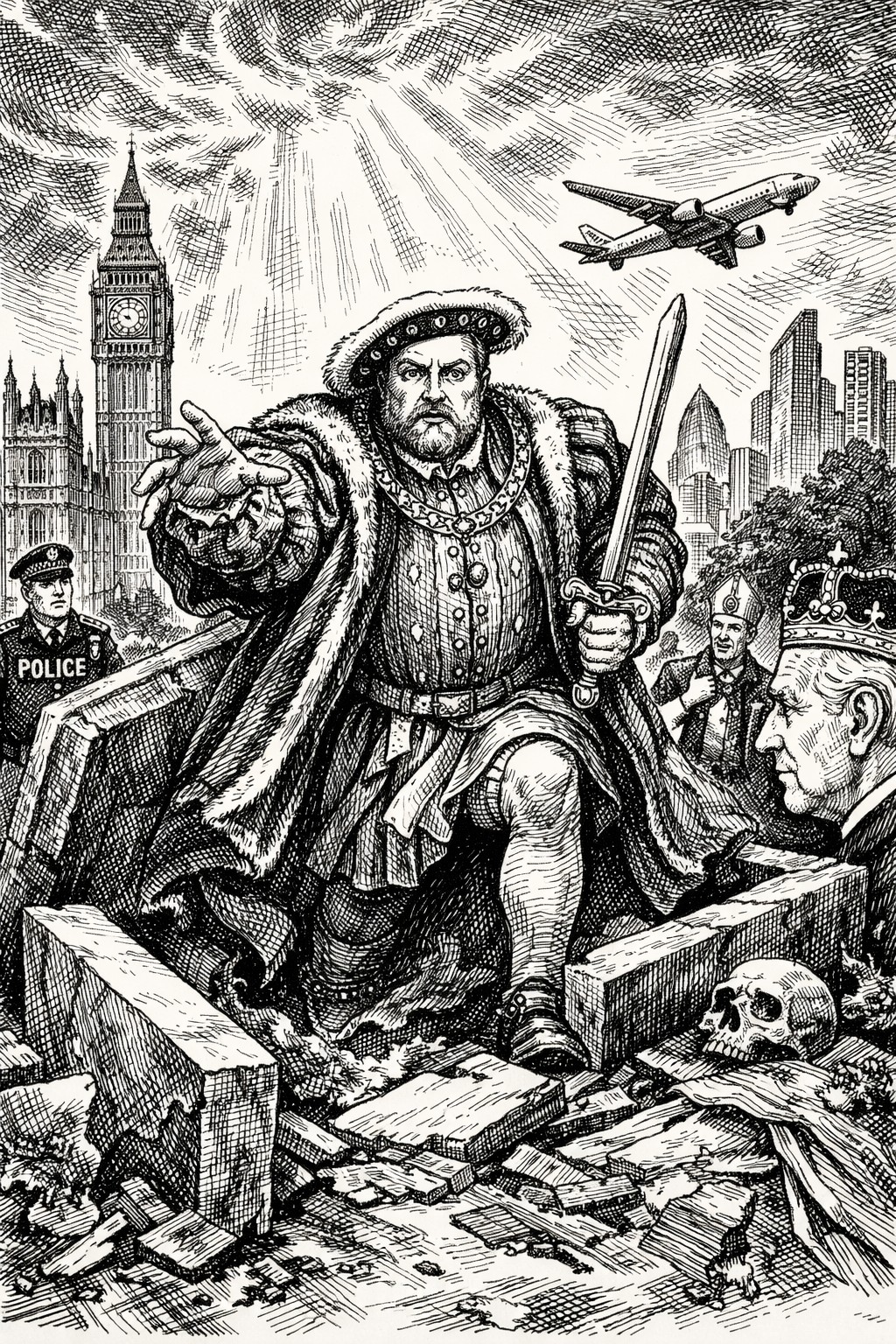
If King Henry VIII were suddenly to return from the dead, the question of how he would interpret his own reappearance is far more complex than choosing between arrogance and enlightenment. Henry was a man of contradictions—pious yet ruthless, sentimental yet suspicious, intellectually curious yet politically paranoid. Imagining his reaction requires exploring the psychology of monarchy, the theology of resurrection, and the shock of a sixteenth‑century mind encountering the twenty‑first century. It also invites a bit of historical theater, which Henry himself would have relished.
At the core of Henry’s identity was an unshakable belief in divine right. He did not see kingship as symbolic or ceremonial. He believed, literally and without hesitation, that God had chosen him to rule. This conviction shaped every major decision of his reign. When he broke from Rome, dissolved the monasteries, and declared himself Supreme Head of the Church of England, he did so not out of mere political convenience but from the certainty that God had placed him above all earthly authorities, including the Pope. A man who believed himself chosen by God does not easily relinquish the idea that his authority is eternal. If Henry VIII opened his eyes in 2026, inhaled the first breath of his second life, and found himself surrounded by unfamiliar machines and customs, his instinct would not be humility. It would be certainty—certainty that God had returned him for a purpose, that kingship once bestowed could not be undone by death, and that the world, however changed, still needed him. In this sense, Henry would almost certainly claim to be King.
Yet the question of whether he would understand that he had died is equally intriguing. Henry was deeply religious, steeped in Catholic theology even after rejecting papal authority. He believed in the immortality of the soul, the resurrection of the dead at the Last Judgment, and the existence of Heaven, Hell, and Purgatory. If he found himself alive again, he would not interpret it as a scientific anomaly or medical marvel. He would interpret it through the lens of Christian eschatology. The most likely conclusion he would reach is that he had been resurrected by God, physically and deliberately. And if God resurrected him, then God must have a mission for him. Henry would not deny that he had died. He would acknowledge it—dramatically, perhaps even proudly. After all, martyrs die, saints die, and Christ himself died. But they return only when God wills it. Henry would see his resurrection as a divine endorsement, a cosmic validation of his kingship, his reforms, and his legacy. He would not be humbled by death. He would be emboldened by resurrection.
Now imagine Henry VIII stepping into twenty‑first‑century London. The skyline alone would stagger him. The absence of horses, the presence of aircraft, the speed of modern life—these would overwhelm his senses. But Henry was not a simple man. He was intelligent, adaptable, and fascinated by technology in his own time. He collected clocks, maps, and scientific instruments. He patronized scholars and engineers. He would not collapse in confusion. He would demand explanations. And once he understood—even vaguely—that centuries had passed, that England had changed, and that monarchy had evolved into a constitutional institution, his reaction would be volcanic. Not because he would feel displaced, but because he would feel needed. A resurrected king, in his mind, would not be bound by parliamentary reforms or modern constitutions. He would see himself as a corrective force, a divine intervention meant to restore order, morality, or authority—whatever he believed the modern world lacked. He would not accept that the monarchy is now symbolic. He would not accept that Parliament holds power. He would not accept that the Church of England is no longer his personal instrument. He would see all of this as evidence that England had drifted dangerously since his death, and he would believe he had been sent to fix it.
Would he try to claim the throne? Absolutely. Henry VIII would not merely claim to be King. He would insist upon it with the full force of his personality—commanding, theatrical, and utterly convinced of his own legitimacy. He would argue that kingship is ordained by God, not Parliament, that death does not nullify divine authority, that resurrection is the ultimate proof of divine favor, and that no modern monarch, however beloved, could claim such a sign. He would likely view the current royal family with a mixture of curiosity and disdain. He would respect their lineage—after all, they descend from his sister Margaret—but he would see their constitutional limitations as a tragic diminishment of royal power. He would not understand why a monarch would accept such constraints. He would not understand why a monarch would not command armies, appoint bishops, or shape national policy. He would see the modern monarchy as a hollowed‑out institution, a ceremonial relic, and he would believe he had been sent to restore its former glory.
Of course, the fantasy collides with reality. In the modern world, kingship is a matter of law, lineage, and constitutional structure. Even if Henry VIII proved his identity beyond doubt—through DNA, historical knowledge, or some miraculous sign—he would not be recognized as King. The monarchy is hereditary, not elective, and Henry’s line ended with his children. But Henry would not accept this. He would argue that his resurrection supersedes all legal frameworks. He would insist that no living monarch could claim greater legitimacy than a king returned from the dead. The public reaction would be extraordinary. Some would see him as a curiosity, others as a religious sign, others as a political threat. Historians would swarm him. Theologians would debate him. Governments would attempt to contain him. And Henry, being Henry, would resist containment with every fiber of his being.
Eventually—after the initial shock, the proclamations, and the demands for recognition—Henry VIII might confront a truth he had never faced in life: the world no longer needs a king like him. Not a warrior‑king, not a theocratic king, not a king who rules by fear, charisma, and divine mandate. He would see a world governed by laws, not monarchs, a world where religion is personal rather than political, a world where women hold power, commoners vote, and kings reign but do not rule. This realization would wound him more deeply than any physical injury he ever suffered. Henry VIII lived for power. He defined himself by it. Without it, he would feel unmoored. And yet, Henry was also a man who reinvented himself repeatedly—athlete, scholar, tyrant, reformer, romantic, despot. He changed roles as easily as he changed wives. It is possible, even plausible, that after the initial fury, he would adapt. He might become a commentator, a cultural figure, a living relic of history. He might lecture on kingship, theology, or statecraft. He might revel in the attention of scholars, journalists, and admirers. He would never stop believing he was King, but he might accept that kingship, in this new world, means something different.
So would Henry VIII claim to be King, or would he simply realize he had died and returned? The most accurate answer is both. Henry VIII would absolutely claim to be King. His identity was inseparable from his crown, and resurrection would only strengthen his conviction that God had chosen him uniquely. But he would also recognize—dramatically, theologically, and with great self‑importance—that he had died and returned. He would not see these as contradictory truths. He would see them as complementary. He died. He returned. Therefore, he is King. In Henry’s mind, resurrection would not diminish his authority. It would complete it.
 Thornical Press