
By Thornical Press –
May 18, 2026
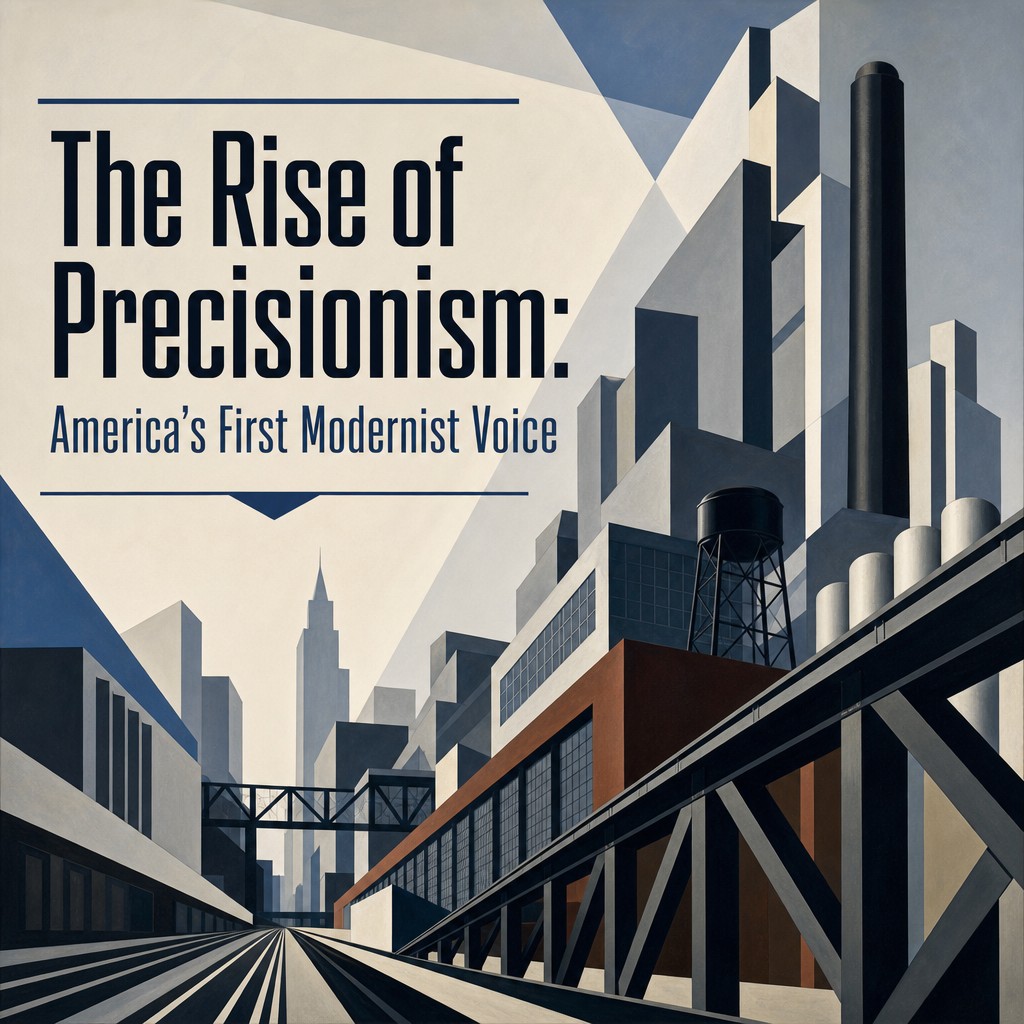
Precisionism did not begin with a manifesto, a school, or a rebellion. It began with a sensation—the shock of seeing America remade in steel, concrete, and right angles. In the years after World War I, the United States entered a period of explosive industrial growth, and the landscape changed with unprecedented speed. Skyscrapers pierced skylines, factories sprawled across riverbanks, and grain elevators rose like new cathedrals on the prairie. For a generation of artists, this engineered world was not merely a subject. It was a revelation. Precisionism emerged from that revelation, becoming the first distinctly American modernist movement, a style that fused the clarity of photography, the geometry of European avant‑garde art, and the optimism, and unease, of the Machine Age. Its rise tells a story about technology, identity, and the search for beauty in unexpected places.
By the 1910s and 1920s, the United States was transforming faster than any other nation. Cities expanded upward and outward, assembly lines redefined labor, and railroads and highways stitched the country together. This new landscape was not picturesque in the traditional sense, but it possessed a stark, undeniable power. Precisionist artists saw in these structures a kind of modern sublime. Factories became temples of industry, skyscrapers became symbols of ambition, and bridges and smokestacks became icons of engineering elegance. Where earlier painters might have lamented the loss of pastoral scenery, Precisionists embraced the clean lines and engineered order of the industrial world. They believed modernity could be beautiful—if one learned to see it properly.
Precisionism is instantly recognizable, defined by a visual language that is crisp, cool, and deliberate. Buildings and machines are reduced to their fundamental shapes—rectangles, cylinders, cones, and planes—so that the world becomes a composition of pure forms. Surfaces are smooth and polished, with brushstrokes nearly invisible, creating an effect that feels almost mechanical. Most Precisionist works are eerily uninhabited, their factories humming without workers and their streets stretching without pedestrians. This emptiness creates a tension: is the scene utopian or alienating? The movement never answers the question outright. Photography played a crucial role in shaping this aesthetic. Sharp-focus images, tight cropping, and exacting detail influenced the way Precisionists composed their paintings, and many of them were photographers themselves.
Although Precisionism was never a formal group, several artists defined its rise. Charles Sheeler, the movement’s quiet master, painted factories, barns, and Shaker interiors with immaculate clarity, and his images of the Ford River Rouge Plant became Precisionism’s signature works. Charles Demuth brought a more playful, abstract sensibility, blending typography, architecture, and Cubist influence in works such as I Saw the Figure 5 in Gold. Elsie Driggs captured the monumental scale of American industry with a cool, ironic beauty, especially in her steel mill paintings. Georgia O’Keeffe, before her desert flowers, painted New York skyscrapers with a Precisionist sensibility—towering, simplified, and luminous. Louis Lozowick, a printmaker, offered a darker, more claustrophobic view of the modern city, revealing the movement’s more anxious edge.
Precisionism mattered because it answered a cultural question: what does American modernity look like? European movements such as Cubism, Futurism, and Purism provided the vocabulary, but Precisionists gave it an American accent. They rejected the idea that modern art had to be imported, and instead found modernity in the nation’s own infrastructure. The movement also bridged realism and abstraction. A Precisionist factory is recognizable, but it is also a study in geometry and rhythm. This duality made the style a stepping stone toward later American movements, including Abstract Expressionism.
Yet beneath its polished surfaces, Precisionism carries a quiet ambivalence. Its coolness can feel calm or unsettling, depending on the viewer. The absence of people can suggest efficiency, or alienation. The monumental structures can feel heroic, or oppressive. This ambiguity is part of the movement’s power. Precisionism captures the emotional complexity of the Machine Age: awe, pride, anxiety, and the sense that technology was reshaping not just cities, but the human experience.
Although the movement peaked in the 1920s and 1930s, its influence persists. Architectural photography owes much to its clarity and geometry, minimalism echoes its reduction of form, and contemporary industrial art continues its fascination with engineered landscapes. American identity still draws on the imagery of factories, bridges, and skyscrapers as symbols of ambition and ingenuity. Precisionism remains a reminder that beauty can be found in unexpected places—on the factory floor, in the shadow of a grain elevator, or along the clean edge of a steel beam catching the afternoon light.
 Thornical Press